Until the mid-19th century, the Earth’s rotation on its axis was accepted largely through astronomical observation and mathematical inference. While compelling, these methods lacked one key ingredient: a direct, physical demonstration.
That changed in 1851, when French physicist Léon Foucault made history with a groundbreaking—and beautifully simple—experiment. He sent out invitations bearing a bold promise:
“You are invited to see the Earth turn.”
A Swing That Shook the World
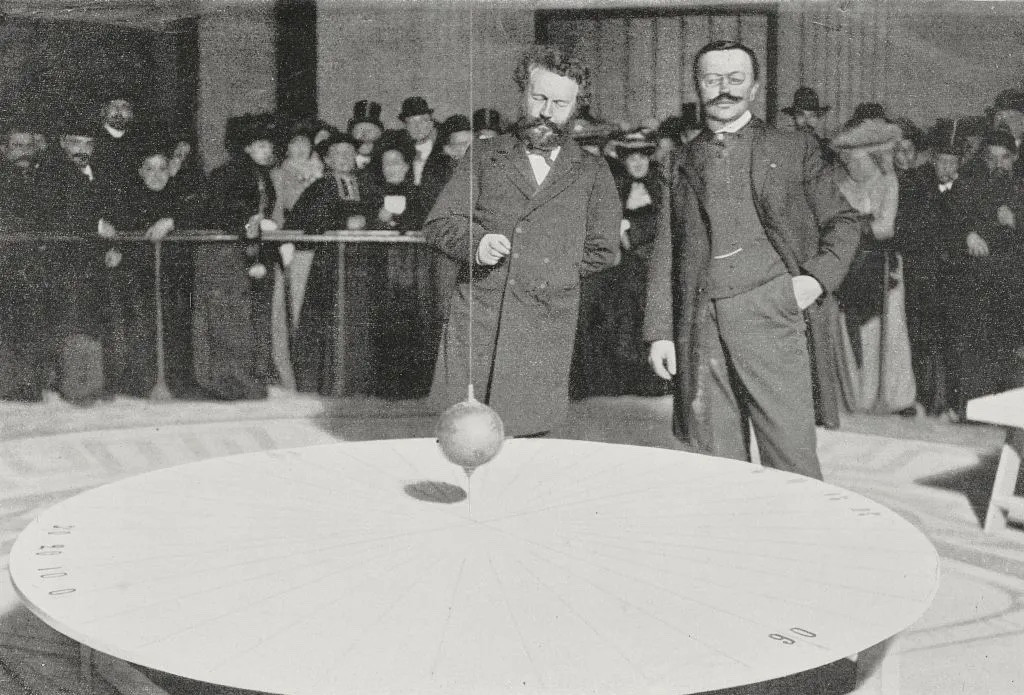
Inside the Paris Observatory, guests gathered to witness the demonstration. Suspended from the ceiling was a 67-meter-long steel wire, holding a 28-kilogram brass sphere with a pointed tip. Beneath it, a flat circular platform was lightly dusted with sand.
At first, it looked like a typical pendulum. Foucault set the massive bob into motion, and it began swinging steadily in a straight line. But as time passed, something unexpected happened: the lines traced by the pendulum’s tip on the sand began to rotate.
The pendulum wasn’t actually changing direction—the Earth beneath it was slowly turning.
Thanks to the laws of physics, a freely swinging pendulum maintains the orientation of its plane of motion. But because the platform—and the Earth itself—was rotating, it appeared to observers that the pendulum’s path was gradually shifting. In reality, the ground was rotating under the pendulum, creating a silent, mesmerizing proof that our planet spins on its axis.
This visual, physical evidence ended centuries of speculation and abstract theorizing. For the first time, you could walk into a room, watch a swinging weight, and see the Earth turning.
A Legacy That Keeps Moving
The brilliance of Foucault’s pendulum lies not only in its clarity, but in its universality. His experiment has been recreated in museums and science centers around the world, continuing to inspire awe more than 170 years later.
One of the most famous replicas is found at the Franklin Institute in Philadelphia. Every morning at 9:30, an 80-kilogram pendulum is pulled back and released. It swings gracefully from north to south, and every 20 minutes, its path knocks over a standing pin. By the end of the day, half the circle of pins has fallen—testament to the steady rotation of the Earth.
A similar installation greets visitors at the CosmoCaixa Science Museum in Barcelona, where Foucault’s quiet revolution continues to resonate.
Foucault’s pendulum transformed a complex astronomical concept into something anyone could observe and understand.
With nothing more than a wire, a weight, and time, it proved one of the most fundamental truths of our planet: the world is, quite literally, turning beneath our feet.