By the 17th century, the science of optics had made significant strides, yet one of its most fundamental mysteries remained unsolved: the true nature of light. While it was known that sunlight could split into different colors, the phenomenon was poorly understood. Many scientists believed that white light was “pure,” and that colors appeared due to impurities or interactions with matter. Meanwhile, widespread religious beliefs held that rainbows were divine symbols—signs from God painted across the sky.
Enter Isaac Newton, one of the most brilliant minds in history.
In 1665, Newton had just completed his studies at Cambridge University when the Great Plague forced the city into lockdown. Like many, he fled to the countryside—retreating to his family’s farm. There, in solitude and silence, he began to explore one of nature’s most beautiful and puzzling phenomena: light.
A Beam, a Prism, and a Breakthrough
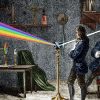
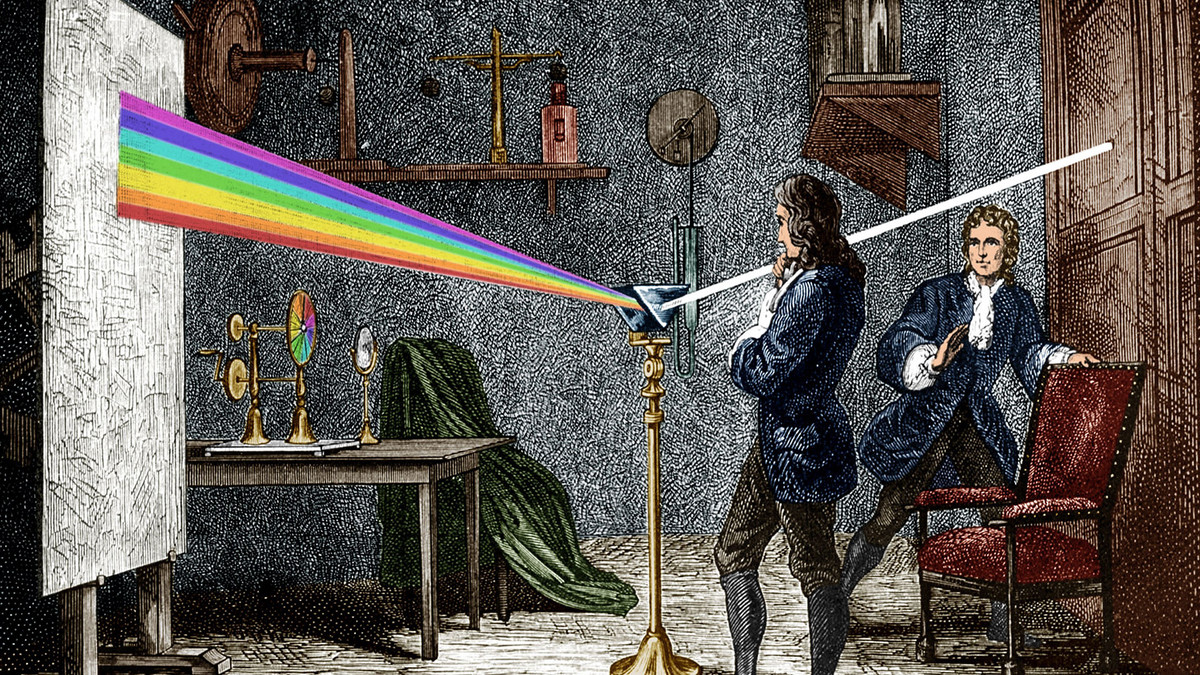
With little more than a prism, a darkened room, and a narrow beam of sunlight, Newton would transform our understanding of the universe. He blocked out all external light and carved a small hole in the window shutter, allowing a thin shaft of sunlight to enter the room. When he positioned the prism in the path of that beam, he witnessed something astonishing.
The white light refracted as it passed through the prism and fanned out onto the opposite wall—not as a single ray, but as a spectrum of colors: red, orange, yellow, green, blue, indigo, and violet. Newton had created a rainbow indoors.
But the real revelation came next. He introduced a second prism, aligned precisely to intercept the spread of colors. Remarkably, this second prism recombined the colors back into a single beam of white light.
This simple but elegant experiment shattered the myth of white light’s purity. Newton had proven that white light was not a singular, divine substance—but a blend of many colors. Color wasn’t an impurity or a trick of the eye—it was inherent in light itself.
A Turning Point in Science and Faith
Newton’s discovery did more than revolutionize optics. It challenged centuries of philosophical and religious thinking. By showing that the rainbow was not a mystical sign but a physical phenomenon governed by laws of nature, Newton helped usher in a new era of rational science.
His groundbreaking work laid the foundation for centuries of optical innovation—from spectroscopy to fiber optics to tunable lasers. More importantly, it demonstrated how observation and experimentation could replace superstition and reveal the hidden structure of reality.